





Losing Weight During Menopause: Why It's Harder & What Works
You may have noticed it yourself: the same habits that “worked” at 30 no longer give the same results. You eat the same, maybe even more carefully, you move the same — and yet the number on the scale creeps up, especially around the middle. It isn't in your head. It isn't a lack of willpower. It's biology, and it has a clear explanation.
The good news is that once you understand what has changed, you can work with your body instead of fighting it with rules that no longer apply. This article doesn't sell you a quick fix — because there's no honest one. It explains what's happening and what the evidence shows genuinely helps.
What changes hormonally (and why it matters for weight)
In perimenopause and menopause, oestrogen levels gradually fall. Oestrogen isn't “just” a reproductive hormone — it has broad metabolic effects. Three of them matter directly for weight:
1. Insulin sensitivity drops. As oestrogen declines, many women become less sensitive to insulin. In practical terms: the body handles carbohydrates less efficiently, and the tendency to store fat — especially around the waist — increases. Fat redistributes from the hips toward the abdomen.
2. Muscle mass declines faster. After 40, the natural loss of muscle mass (sarcopenia) accelerates, and falling oestrogen contributes. Muscle is the tissue that burns the most energy at rest. Less muscle means a slower resting metabolism — so you burn fewer calories even when you're doing nothing.
3. Sleep and cortisol get disrupted. The hot flushes and insomnia common in this period raise cortisol, the stress hormone. Chronically elevated cortisol drives sugar cravings and abdominal fat storage — and closes a vicious circle with poor sleep.
Put them together and you understand why it feels like your “metabolism is stuck.” It isn't stuck — the rules changed.
Why the diets that used to work no longer do
The model most of us grew up with — “eat less, move more,” preferably through drastic restriction — is exactly the wrong approach at menopause, for two reasons.
Severe restriction attacks muscle. When you cut calories aggressively without enough protein and without strength training, a significant part of what you lose is muscle, not fat. The result: the scale drops in the short term, but metabolism slows further, and the weight comes back — often with a higher fat percentage than before. It's the most counterproductive thing you can do right now.
Cardio alone isn't enough. Hours of aerobic exercise help your heart and mood, but they don't fix the loss of muscle mass, which is the core of the metabolic problem at this age.
In other words: you don't need more restriction. You need a different strategy.
The four pillars that make the difference
Research and clinical practice converge on four directions. None is spectacular. Together, they work.
Pillar 1 — Enough protein
This is the most important change for most women, and the most neglected. Protein does three things you need now: it protects and supports muscle mass (especially combined with strength training), it provides stronger satiety than carbohydrates or fats, and it has a higher thermic effect (the body uses more energy to digest it).
In the EU, protein carries authorised health claims: it contributes to a growth in muscle mass, to the maintenance of muscle mass, and to the maintenance of normal bones — and bone health itself becomes a priority at menopause.
In practice: distribute protein across every meal, not just dinner. Many women find breakfast is the meal where they fall short. When food alone doesn't cover the requirement, a quality protein powder can top it up conveniently. That's where PROTEIN+ fits in our range.
Pillar 2 — Strength training
If you were to add a single type of movement, it would be strength training — with weights, resistance bands or your own bodyweight. It's the only lever that rebuilds lost muscle and, through it, reactivates resting metabolism. As a bonus, it loads the bones and supports their density, which matters enormously after menopause.
You don't need a gym or complicated programmes. Two or three progressive sessions a week make a real difference within a few months.
Pillar 3 — Sleep and cortisol management
Sleep isn't a luxury, it's part of the strategy. Insufficient sleep increases sugar cravings, further lowers insulin sensitivity and keeps cortisol elevated. Prioritise a consistent evening ritual, reduce screens before bed, and address the hot flushes that interrupt your sleep (sometimes worth discussing with your doctor). Reducing chronic stress — even through walks, breathing, phone-free time — works directly against abdominal fat.
Pillar 4 — Blood-sugar balance
Because insulin sensitivity drops, how you eat carbohydrates matters more than before. This doesn't mean “no carbs” — it means smarter carbs: from whole sources, paired with protein and fibre, which flatten the blood-sugar spikes. Meal order (vegetables and protein before carbohydrates) and light movement after meals help more than you'd think.
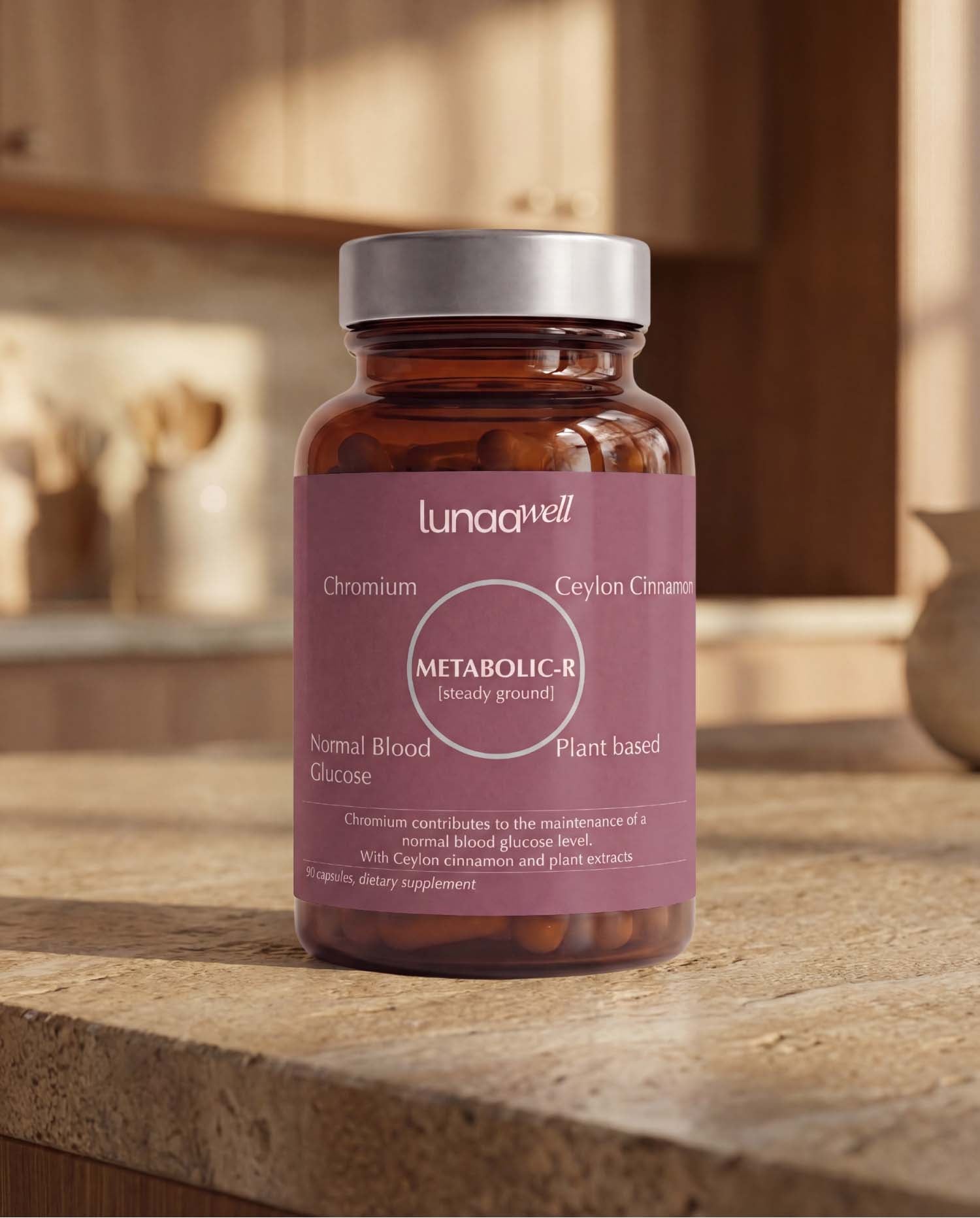
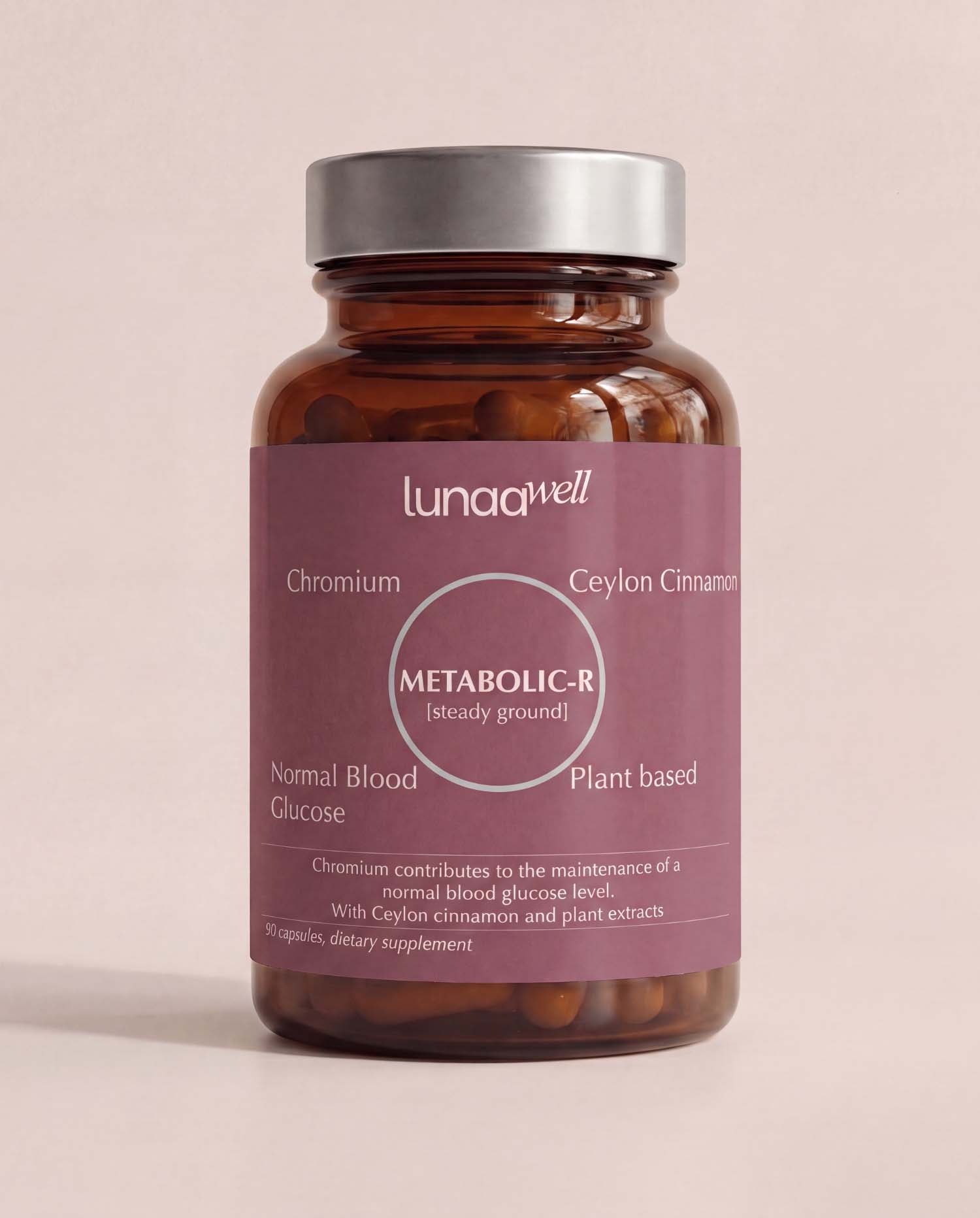
To support this pillar, some women choose metabolism-oriented formulas. They're worth understanding correctly: they support, they don't replace, the three pillars above. If you want to go deeper on the ingredients frequently discussed here, read our guide to berberine and our guide to insulin resistance. Our formula in this area, METABOLIC-R, combines ingredients including chromium, which contributes to the maintenance of normal blood glucose levels.
A realistic sample week
Not a rigid plan — a framework you adapt:
- Protein at every meal, with emphasis on breakfast (eggs, Greek yoghurt, a protein powder — whatever is convenient).
- Strength 2–3 times a week, plus light daily movement (walking counts).
- A consistent sleep ritual, the same bedtime including weekends where possible.
- Meals built around vegetables and protein, with whole-grain carbohydrates as a side, not the base.
- Patience with the process. Body recomposition — more muscle, less fat — doesn't always show on the scale, but it shows in how your clothes fit and in your energy.
An important word about expectations: the goal isn't to return to your 25-year-old body, but to a strong, energetic and healthy body at the age you are. The measure of success isn't just a number on the scale.
Frequently asked questions
Can you really lose weight during menopause?
Yes, but through the strategy suited to this stage — enough protein, strength, sleep, blood-sugar balance — not through drastic restriction, which backfires.
Why am I gaining weight around the middle even though I'm not eating more?
Falling oestrogen redistributes fat from the hips toward the abdomen and reduces insulin sensitivity. It's a hormonal pattern, not a consequence of “lack of discipline.”
Do supplements help me lose weight?
No supplement makes you lose weight, and no one should present it that way. Some can support the pillars above — protein for muscle mass, for example — but the result comes from habits, not from a pill.
How long until I see results?
Body-composition changes through strength and protein generally appear within a few months of consistency. It's a slower process, but a durable one — unlike crash diets.
This article is for informational and educational purposes. It does not constitute medical advice and does not replace consultation with a doctor. Menopause can involve symptoms worth evaluating individually; discuss any significant change in weight, sleep or mood with your doctor. Food supplements are not a substitute for a varied, balanced diet.
Read more

What berberine is, how it affects metabolism, what the studies show, how it's typically taken and what precautions matter. A source-based guide.

What "liposomal" actually means, what absorption studies show, how to spot a genuine product and when the upgrade is worth it. A clear, hype-free guide.