


Chronic Cortisol in Women: Symptoms, the Belly Fat Connection, and How to Lower It Naturally
You wake at 3:17 a.m. Your heart is pounding, your mind boots up with a worry list that wasn't there at 11 p.m. By 7 a.m., after a fragmented night, you feel "wired but tired" — restless yet depleted. By 3 p.m., you hit a crash that neither coffee nor a walk outside can shift. And your belly — your belly has gained three centimeters in six months, even though the scale has only crept up by one kilo. It's not in your head. It's cortisol.
What cortisol actually is — and what "chronically elevated cortisol" really means
Cortisol is the hormone produced by the adrenal glands, essential for life: it wakes you in the morning, mobilizes energy under stress, regulates blood sugar, controls inflammation, and supports blood pressure. The problem isn't cortisol itself — it's cortisol that is chronically unbalanced.
On a normal day, cortisol follows a predictable curve: a peak 30–45 minutes after waking (the cortisol awakening response), a gradual decline through the day, and a low point between midnight and 2 a.m. This curve regulates almost everything — sleep, energy, appetite, mental clarity, ovulation, libido.
In chronic imbalance, the curve flattens or inverts: cortisol that's too low in the morning (you wake exhausted), unexpected spikes at midday and in the evening, a false nocturnal peak at 3–4 a.m. that jolts you awake. This dysregulation is what "chronically elevated cortisol" tends to mean in everyday language — even when 24-hour averages don't look abnormal on a blood test.
Why cortisol affects women differently after 35
Cortisol doesn't work in isolation — it's deeply modulated by estrogen, progesterone, and thyroid hormones. Three realities make cortisol imbalance a distinctly female problem in perimenopause and beyond:
- Estrogen tempers the stress response. When estrogen swings (perimenopause) or declines (menopause), the brain becomes more reactive to stressors — the same work conflict produces a cortisol surge 1.5–2x larger than it would have in your 20s or 30s.
- Progesterone, your natural calmer, drops first. In perimenopause, progesterone production falls by 75% before estrogen itself collapses. You lose your built-in buffer against cortisol.
- Women have a more sensitive diurnal curve. Studies show that in women, fragmented sleep produces far more pronounced cortisol dysregulation than in men — and we're more often exposed to fragmented sleep (children, a snoring partner, hormonal awakenings).
The result: women between 35 and 55 are the cohort with the highest incidence of cortisol dysregulation, even when their lives wouldn't be called "stressful" in the classic sense.
7 signs your cortisol is chronically out of balance
If you check 4 or more of the symptoms below and they've persisted for at least 3–4 months, your cortisol axis is very likely dysregulated:
- Abdominal fat that won't budge — even in women who are otherwise lean. Cortisol directs fat storage to the belly (visceral fat), the most inflammatory kind.
- Waking between 2 and 4 a.m. — unable to drift back to sleep easily. It's the signature of cortisol rising prematurely, or of nocturnal hypoglycemia.
- "Wired but tired" — physical exhaustion paired with a hyperactive mind, especially in the evening. Cortisol stays elevated when it should be at its lowest.
- Intense cravings for sugar or salt at 3–4 p.m. — cortisol drops blood sugar, and the brain demands fast fuel.
- Irritability out of proportion to the trigger — emotional reactions far more intense than the situation warrants.
- Hormonal acne along the jawline or chin — especially before your period. Cortisol raises androgens.
- Frequent colds or lingering viral illnesses — chronic cortisol suppresses the immune system.
Bonus: if your menstrual cycle has become irregular (shorter, longer, or spotting), and your thyroid tests are normal, cortisol is the prime suspect — it directly affects ovulation via the hypothalamic-pituitary axis.
The cortisol → insulin → belly fat connection
Chronic cortisol drives weight gain not because it "makes you eat more" (though it does that too), but through a specific biochemical mechanism:
- Elevated cortisol prompts the liver to produce glucose from protein (gluconeogenesis) — even when you haven't eaten.
- Rising blood sugar triggers insulin.
- Chronically elevated insulin → insulin resistance.
- Insulin resistance → the body preferentially stores fat on the abdomen (visceral), around the organs.
- Visceral fat itself produces inflammation and cortisol → a vicious cycle.
This is why "dieting" alone rarely resolves stress-induced belly fat — even when you cut calories, as long as cortisol stays elevated, the abdominal storage signal doesn't switch off. The solution has to address cortisol directly.
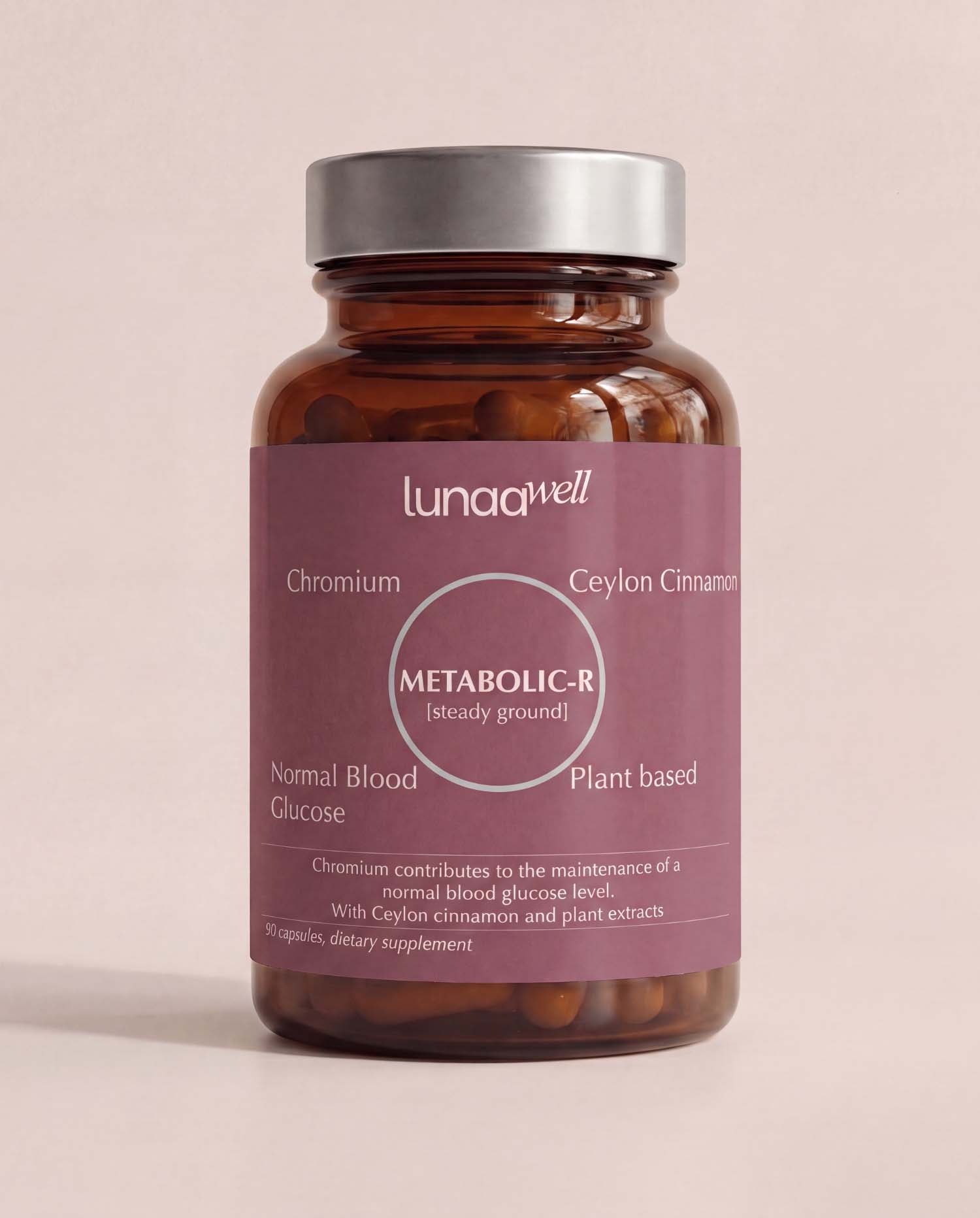
And this is why restoring insulin sensitivity is the second critical intervention. Metabolic-R Glucose is formulated with chromium picolinate and metabolic co-factors that interrupt this cycle — improving cellular insulin response, even under cortisol pressure.
5 nutrients and plants that lower cortisol
1. Magnesium glycinate — the foundation
Magnesium is the most depleted mineral in women after 35. Chronic stress drains it (it's consumed in the cortisol response), and without enough magnesium, the parasympathetic nervous system ("rest and digest") can't take over. The glycinate form crosses the blood-brain barrier and has a calming effect without a laxative effect.
Dose: 200–400 mg, 60–90 minutes before bed. Effect: deeper sleep within 3–5 days, reduced anxiety within 2–3 weeks.
2. Holy basil (tulsi) — a gentle adaptogen with a direct effect on cortisol
Ocimum tenuiflorum (Indian holy basil, or "tulsi") is one of the best-documented adaptogens for the cortisol axis. Clinical studies show reductions of 25–30% in morning serum cortisol and improvements in perceived anxiety after 6–8 weeks of 500–750 mg of standardized extract per day. Unlike the more stimulating adaptogens, tulsi has a calming profile without sedation — it can be taken morning or evening.
Bonus: holy basil supports blood sugar balance and has anti-inflammatory effects, which makes it especially well-suited to the cortisol → insulin resistance → abdominal fat cluster. It's the adaptogen of choice when you want cortisol modulation without hormonal side effects (unlike others that can interfere with the thyroid or fertility).
Note: don't take it alongside anticoagulant or thyroid medications without medical supervision. Contraindicated in pregnancy and breastfeeding.
3. Rhodiola — for "wired but tired" depletion
Rhodiola rosea works differently from holy basil — it doesn't lower cortisol directly, but it improves stress tolerance and reduces energy burnout. It's better suited if you feel depleted rather than agitated. Studies show a 30–40% reduction in chronic fatigue after 4 weeks of 200–400 mg/day.
Take it in the morning — it can be too stimulating in the evening.
4. L-theanine — fast effect, no sedation
An amino acid from green tea, L-theanine raises alpha brain waves (a state of focused calm) within 30–40 minutes. 200–400 mg before a stressful event or in the evening lowers acute cortisol without making you drowsy.
5. Vitamin C — fuel for the adrenals
The adrenal glands hold the highest concentration of vitamin C in the body and burn through it quickly under chronic stress. Doses of 500–1000 mg per day, split into two servings, support balanced cortisol production. Food sources: red peppers, kiwi, citrus, leafy greens.
4 lifestyle strategies with rapid impact
1. Natural light in the first 30 minutes after waking
The most powerful signal for re-syncing the cortisol curve. 10–15 minutes of direct sunlight (even on a cloudy day) or a 10,000-lux lamp at the window, first thing in the morning, "sets" cortisol to rise when it should (in the morning) and to fall when it should (in the evening). Visible effect within 3–7 days.
2. Coffee only after 90 minutes of being awake
Coffee consumed the moment you wake up "layers" on top of your natural cortisol peak and creates a need for ever-larger doses. Wait 90 minutes — your natural peak will do the work, and the coffee will be more effective later. Bonus: stop coffee completely after noon to 1 p.m. — caffeine's half-life in perimenopausal women rises to 8–10 hours.
3. 4-7-8 breathing or box breathing
4 seconds inhale, 7 seconds hold, 8 seconds exhale — repeat 4 times. Activates the parasympathetic nervous system and lowers cortisol within 90 seconds, measured in studies. Use it before a tense meeting, before bed, or if you wake at 3 a.m.
4. Moderate movement, not intense, on stressful days
Intense workouts (long HIIT, hard running) raise cortisol acutely. Useful on days of mental rest. But on days with heavy work stress, choose a 30–40 min walk outdoors, yoga, or easy swimming — they lower cortisol directly without adding extra physical stress.
An AM-PM protocol for cortisol reset
If you want a concrete starting framework:
Morning (first 90 minutes):
- 10–15 min of natural light + 5 min of slow breathing outside
- Water with Himalayan salt and a teaspoon of lemon juice (electrolyte rehydration)
- Breakfast with 25–30 g of protein — Plant Protein + flax seeds + blueberries is a combination that stabilizes blood sugar for 4–5 hours
- Coffee only after 90 minutes, with a snack containing healthy fat (nuts, avocado)
Through the day:
- 3–4 meals with protein + fiber + fats (not sugary snacks)
- Box breathing, 4 cycles before any stressful meal (meeting, conflict)
- 10–15 min walk after lunch (lowers cortisol + stabilizes blood sugar)
- Stop coffee after noon to 1 p.m.
Evening (after 6 p.m.):
- Last meal at least 3 hours before sleep
- Low/warm light at home (red light bulbs or apps that reduce blue light)
- Magnesium glycinate 300 mg + (optional) holy basil extract 500 mg
- Cool bedroom (18–19°C / 64–66°F), no phones, no TV for 60 minutes before bed
- Box breathing if you go to bed restless
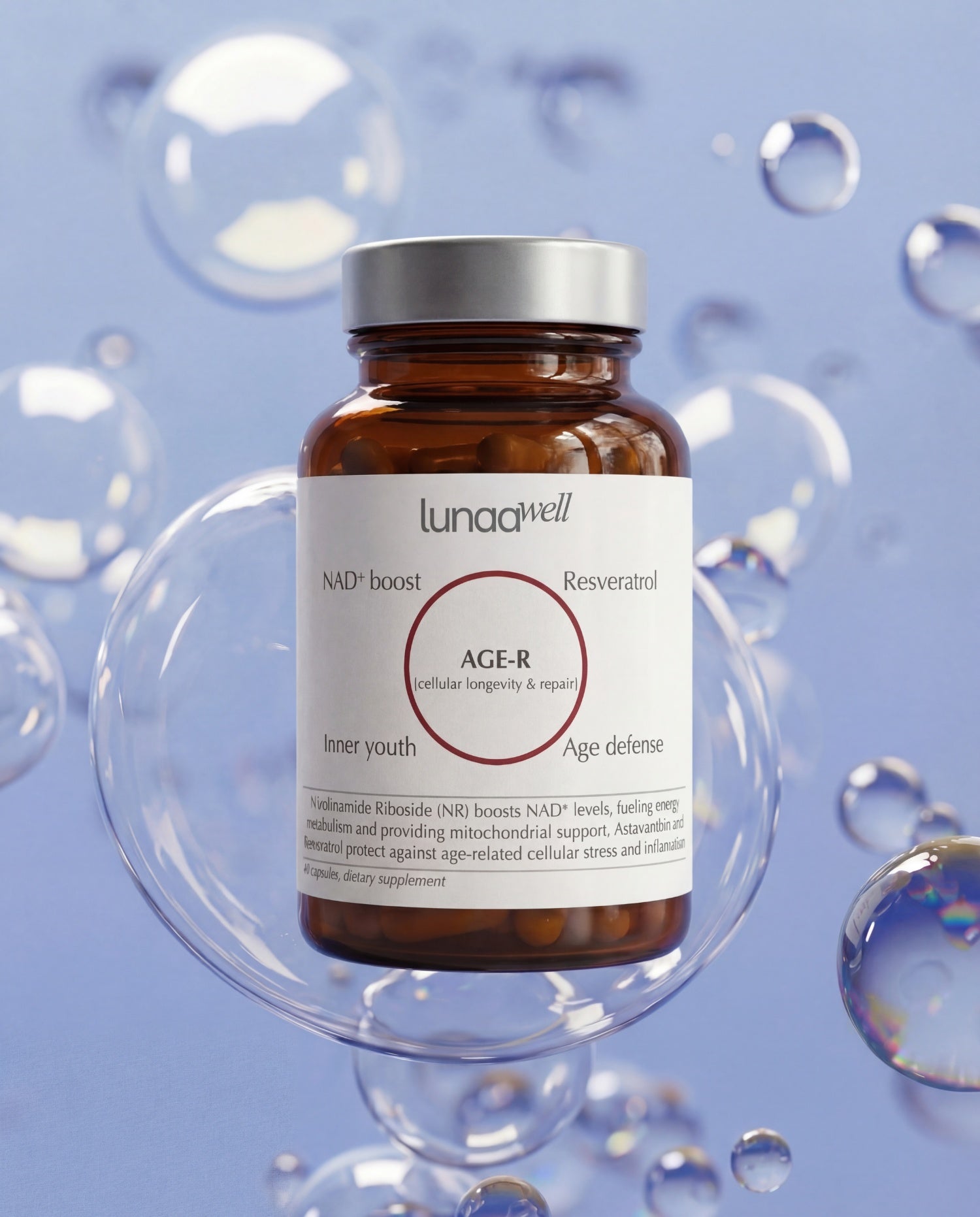
For the mitochondrial fatigue that accompanies cortisol dysregulation: if alongside elevated cortisol you're also dealing with chronic fatigue or a 3 p.m. crash that won't lift, the problem is twofold — adrenals + mitochondria. Age-R NAD+ Complex supports cellular energy production in exactly this window.
If you want an integrated framework: the rituals above (morning light, consistent protein, moderate movement, targeted supplementation, slow breathing, protected sleep) are more effective practiced together than in isolation. Lunaa Reset™ — the self-paced 28-day program structures all of these rituals into a protocol guided by your own rhythm, with daily steps for recalibrating the stress axis, metabolism, and cellular energy. For women who prefer an integrated experience over a collage of individual tactics, it's the fastest path to consistency.
Frequently asked questions about cortisol and women's health
How do I test my cortisol level accurately?
A 4-point salivary test (morning, noon, evening, night) is the gold standard for seeing the curve — more informative than a single blood test, which only captures a snapshot. It's done in specialized labs or through kits ordered online. Cost: roughly $50–$100. Ask for a referral from a functional medicine physician or endocrinologist familiar with it.
Can I take holy basil and magnesium together?
Yes, they're synergistic. Magnesium supports muscle relaxation and sleep; holy basil directly modulates cortisol and supports blood sugar balance. The combination works better than either alone for nighttime anxiety and 3 a.m. waking. Start with low doses and increase gradually to assess individual tolerance.
How long does it take for cortisol to "normalize"?
Sleep and the quality of your waking improve within 7–14 days with a consistent protocol. Stress-induced belly fat begins to soften after 6–8 weeks. Full recovery of the adrenal axis, in cases of chronic depletion, takes 3–6 months. The key is consistency — not intensity.
Does intense cardio lower or raise cortisol?
Short-term, it raises it (acutely). Long-term, if dosed correctly (3–4x per week, sessions under 45 minutes), it improves regulation of the axis. If overdone (daily long runs, daily HIIT) in a woman who's already stressed, it accelerates depletion. The rule: if you feel more depleted after a workout than before, dial it down.
Is there a link between cortisol and hormonal acne?
Yes, a direct one. Cortisol stimulates the sebaceous glands and raises androgen production (testosterone, DHEA). Acne on the jawline, chin, and neck in the pre-menstrual week is the classic cortisol-androgen signature. Regulating cortisol improves acne more than most topical treatments.
The takeaway that matters
Cortisol isn't the enemy — it's the messenger. It's telling you that you've been in "survival mode" for too long and that your hormonal axis is asking for recalibration. Diet alone doesn't fix cortisol. Cardio alone doesn't fix cortisol. Willpower doesn't fix cortisol. What works is a consistent sequence of biological signals you send your body every day: morning light, protein at meals, moderate movement, targeted supplementation, slow breathing, protected sleep.
Within 4–6 weeks of a consistent protocol, most women notice the change they didn't think was possible: you sleep better, you wake without anxiety, your belly begins to give, your energy holds through the evening, and your patience with the people around you returns. It isn't magic. It's biology, realigned.
Note: This article is for educational purposes and does not replace medical consultation. Chronically unbalanced cortisol can be a sign of endocrine conditions that require medical evaluation (Cushing's syndrome, adrenal insufficiency, hypothyroidism). Before starting any supplementation protocol, especially if you're on prescribed medication or have a diagnosed condition, consult your doctor.
Found this helpful? Share with someone who needs it.
Share on InstagramRead more

Perimenopause changes metabolism after 35. Complete guide: why you gain weight, the 5 pillars of metabolic reset, and a 28-day protocol for women.

What berberine is, how it affects metabolism, what the studies show, how it's typically taken and what precautions matter. A source-based guide.